· Jake Sorensen
Fly Fishing Pliers: What Actually Changes for the Fly Angler
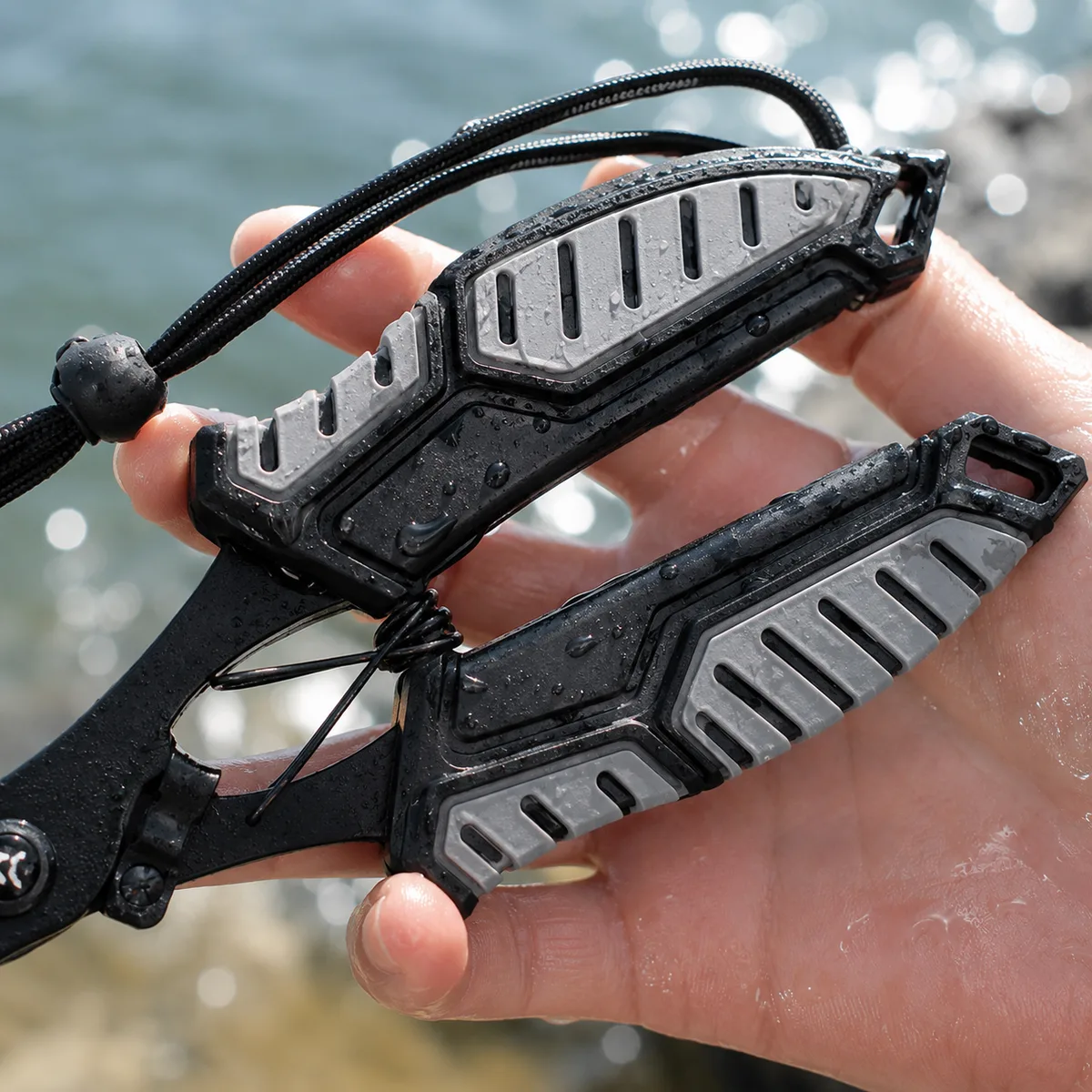
Search for fly fishing pliers and most of what comes back is a general tackle plier photographed next to a fly box. The tool has not changed; the photograph has. What does change is the job. A fly angler puts a plier to work on hooks tied on fine wire, on tippet a fraction the diameter of a bass leader, on fish that are going back into the river, and from a vest that already carries everything else for the day. Those four facts decide what the tool has to be, and where the HookGrip build lands against each.
What fly fishing asks of a plier that other fishing does not
A plier on a bass boat spends its day on treble hooks, braid and split rings. A plier on a trout stream spends it on a single small hook, a length of mono or fluorocarbon tippet, and a fish that has to be back in the water inside the time it takes to read this sentence. Same tool, different day — and four demands move to the front of the queue.
- A tip that closes on a small target. The bend of a fly hook is the target, and it sits inside the mouth of a fish that has not agreed to hold still. A broad, blunt jaw covers the hook and the fish together; a narrow tip takes the hook alone.
- A cut that leaves tippet clean. A frayed tag end on a bass leader is a nuisance. On tippet it means the knot does not seat, and the next fish is lost at the tie rather than in the fight.
- A jaw that flattens a barb in one squeeze. Barbless is the habit of the discipline and, on some water, the rule. The plier does the pinching at the bench, before any of it matters.
- A weight the vest does not notice. Everything a fly angler carries hangs from the same shoulders all day, and the plier keeps its place among twenty other items by grams.
The barb comes off at the bench, and on some water the rule is written down
Fly anglers pinch barbs for a practical reason and a regulatory one, and the two say the same thing. The practical reason: a hook without a barb backs out along its own path in one motion, so the fish is held for less time and the hole in its jaw stays a hole rather than becoming a tear. The regulatory reason is written down, water by water, and the clearest example is Yellowstone.
Yellowstone National Park states both the rule and the reason. Its fishing regulations require that "hooks must have points that are barbless, or the barbs must be pinched down by pliers", and the park says it adopted the rule "to reduce handling time and injury" on its heavily-fished waters. The same page keeps three rivers — the Firehole, the Madison and the lower Gibbon below the falls — fly-fishing only, and requires every native fish, cutthroat trout included, to be released unharmed. Then it says what to use: "With small pliers you must pinch down the barbs."
That last line is the fly fishing pliers brief in nine words: the tool that pinches the barb at the bench is the tool that takes the hook out on the bank. Our how to use fishing pliers guide walks through the squeeze itself — where to place the jaw, why to close slowly, how to check the point on a fingernail — so this article stays on what the discipline asks rather than repeating the technique.
in Yellowstone — the Firehole, the Madison and the lower Gibbon — are fly-fishing only, and every hook in the park must be barbless or pinched flat with pliers
— U.S. National Park Service, Yellowstone fishing regulations, 2026
Small hooks and fine tippet: where the tip and the cutting edge sit
Two parts of the jaw do the fly angler's work, and neither is the part a listing photograph shows off.
The first is the tip. HookGrip's jaw is machined to a narrow, pointed profile built to find the seam between the two coils of a split ring — the geometry is laid out on our split ring pliers page. A tip built to find a seam that small closes on the bend or shank of a hook rather than on the fish around it, and that is the difference between a release that takes one motion and one that takes three.
The second is the cutting notch, which sits close to the pivot rather than out at the tip. That placement is where the jaw has the most mechanical advantage, and it is the reason fine tippet shears in one closing instead of rolling away from the edge. The stainless jaw is built to cut mono, fluorocarbon and braided line, and tippet is the first two. Seat the tippet deep in the notch, hold light tension on both sides, close once. The tag end that comes off threads a hook eye on the first try — which, with tippet, is the whole point of the cut.
A third moment belongs to the cutting edge, and nobody plans for it. When a fish is hooked deep and the point is out of sight, the established call — Yellowstone prints it as an instruction — is to cut the line as close to the hook as you safely can rather than pull. The plier that trimmed the tippet is already in your hand for that job.
The clamp on the vest, and what a plier adds to it
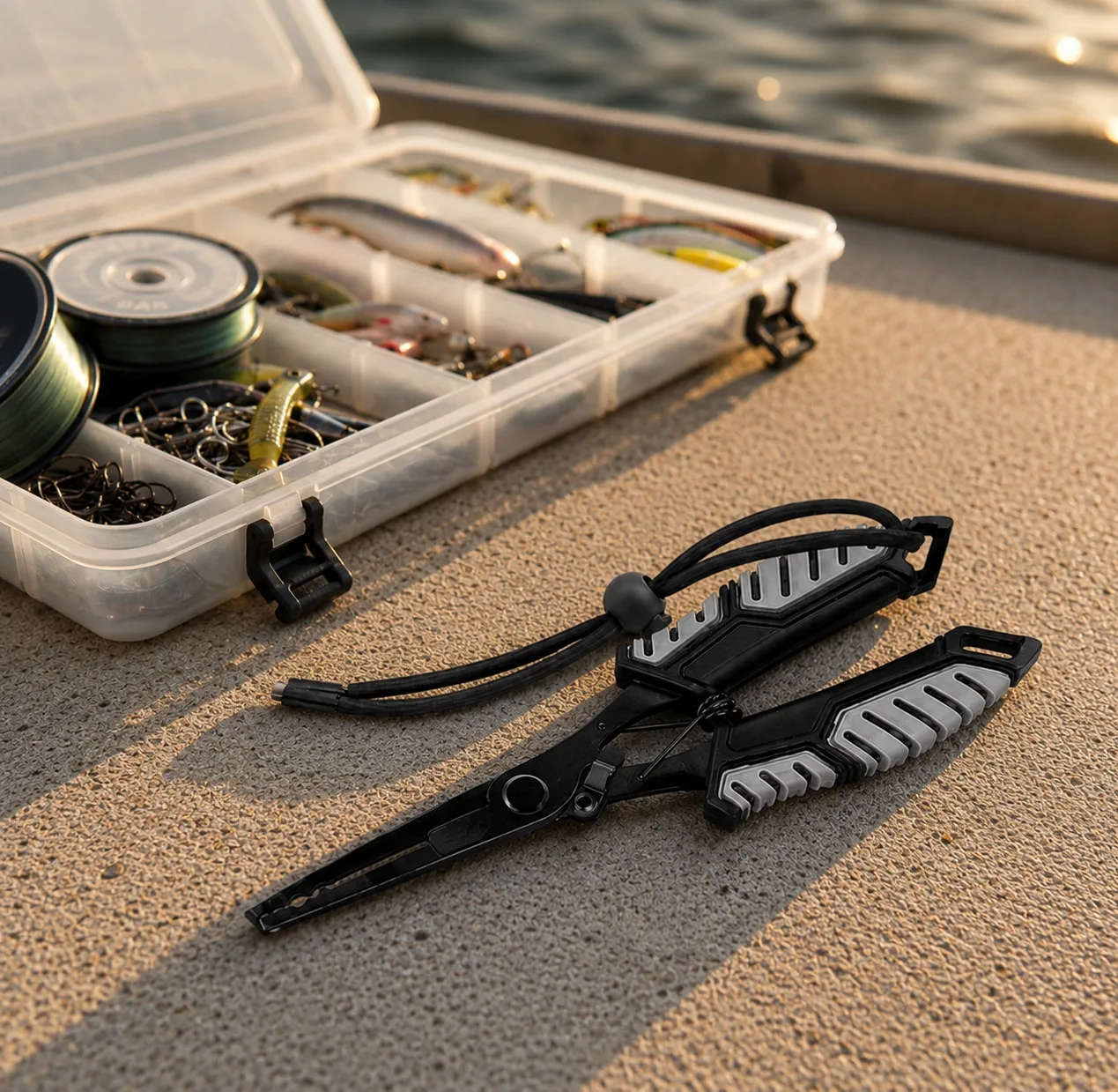
Most fly vests already carry a locking clamp: a slim pair of forceps that closes on a hook shank and stays closed until it is released. It holds; that is its entire job description.
A fishing plier holds a hook shank too, with the same choked-up grip, and then does three things a clamp was never designed to do. It cuts: tippet, a knot tag, the line on a deep-hooked fish. It presses: a barb flattened in one squeeze at the bench, a snap closed until it seats. And it opens: a split ring on a streamer, a hook eye held still while cold fingers thread tippet through it. Four jobs on one lanyard, where a clamp answers one of them and a separate pair of nippers answers part of another.
The handles matter more here than on a boat, because a wading angler's hands are wet from the first cast and stay wet. HookGrip's handles are textured TPR rather than smooth plastic or bare metal, so the jaw lands where it was aimed — on a hook that is inside a fish — instead of rotating in a wet palm as force goes on.
Weight is the spec a wading angler feels
Every gram on a fly vest is paid for in the shoulders by four in the afternoon, and a plier competes for its place with fly boxes, tippet spools, floatant, a net and a water bottle. The solid stainless builds our best fishing pliers guide compares run 120 to 200 grams and up in the hand. HookGrip weighs 90 grams. The number comes from a light ABS composite body around a stainless steel jaw: metal only where the cutting and gripping happen, composite everywhere else.
Ninety grams changes a habit. A tool that light stays on the vest; a heavier one migrates to the pack, and the pack is on the bank while the fish is in the net. The lanyard closes the loop: an eyelet is moulded into the end of the HookGrip handle, and a coiled tether through it turns a drop in fast water into a tool swinging from a zinger. Between fish, the belt pouch that ships with every order keeps the jaw from blunting itself against a box of flies — our guide to fishing pliers with a sheath covers what the case protects and how it clips on.
total weight of HookGrip pliers — ABS body, stainless steel jaw and TPR handles included — light enough to stay on a vest all day
— HookGrip product specifications, 2026
Freshwater most days, salt on the flats: the jaw material
Fly fishing lives mostly in fresh water, which is easy on a stainless jaw. But the discipline has a saltwater side — flats, estuaries, surf — and salt left to dry in a pivot or a cutting notch works its way into any metal. The fix is the one every HookGrip page repeats: rinse the jaw in fresh water after a salt trip, dry it, store it open rather than clamped shut and wet.
What the material buys is a margin for forgetting. We put three units through a 24-hour saltwater soak, rinsed and dried them, and checked the cutting edge on 20 lb monofilament afterwards: all three cut cleanly with no visible pitting, and the exact method is on our stainless steel fishing pliers page. The ABS body has no metal in it to corrode at all. For anglers weighing that jaw against a titanium frame, our titanium vs stainless steel comparison works through density, stiffness and edge retention metal by metal; the conclusion is that on a plier, the jaw decides, and the jaw is stainless steel.
Where the HookGrip build lands for the fly angler
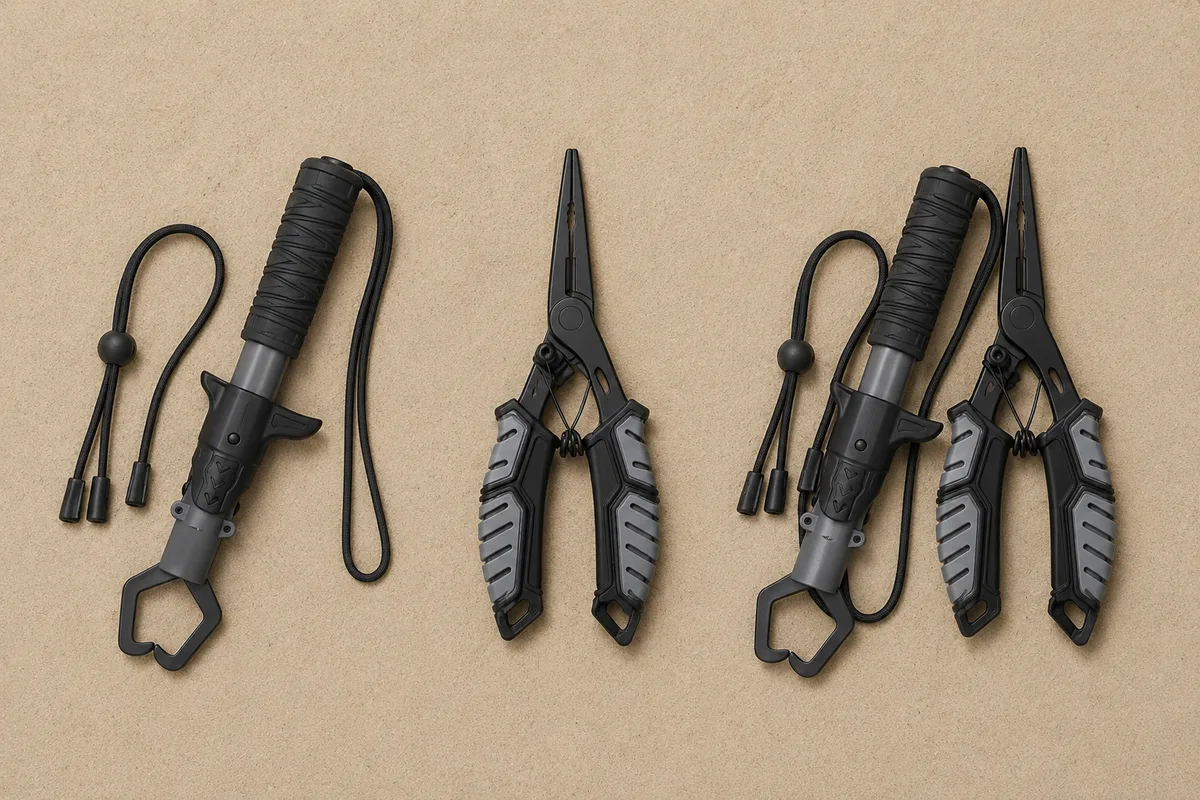
Measured against the four demands at the top of this article: the tip is narrow and pointed, the profile the split-ring page describes, so it closes on the hook rather than the fish; the cutting notch sits at the pivot and shears mono and fluorocarbon tippet in one closing; the stainless jaw flattens a barb in a single firm squeeze; and the whole tool weighs 90 grams, with a lanyard eyelet moulded into the handle and a belt pouch in the box. The pliers are $24.95 on their own. For anglers who also fish toothed species on the fly, the Pliers + Grips Combo adds a fish gripper for $39.95, and the Grips alone are $19.95.
HookGrip is rated 4.8/5 across 288 verified buyers, with free shipping and a 30-day guarantee on every order. It is sized for the hooks and the fish a fly angler meets on most days — small to mid-size, in fresh water and light salt — and built to be the one tool that pinches the barb, takes the hook and trims the tippet, on the vest, every trip.
average rating across 288 verified buyer reviews of the HookGrip lineup
— HookGrip verified buyer data, 2026
Frequently asked questions
What do fly fishing pliers do that a clamp does not?
A clamp holds a hook shank. Fishing pliers hold it too, then cut the tippet, pinch a barb flat in one squeeze, open a split ring and close a snap until it seats — four jobs on the one tool hanging from the lanyard.
Can HookGrip pliers pinch down the barb on a fly hook?
Yes. Place the stainless jaw across the barb, close slowly in one firm squeeze, and run the point over a fingernail: a flattened barb tracks smoothly. Do it at the tying bench, before the fly is on the water.
Are barbless hooks required for fly fishing?
It depends on the water. Yellowstone National Park requires every hook to be barbless or pinched down with pliers, and keeps the Firehole, the Madison and the lower Gibbon fly-fishing only. Other rivers set their own rules, so read the regulation for the water you fish before you tie on.
Will fishing pliers cut tippet cleanly?
Yes. The HookGrip stainless jaw is built to shear mono, fluorocarbon and braided line, and tippet is the first two. Seat the tippet close to the pivot, hold light tension on both sides, and close once — the tag end threads a hook eye on the first try.

Jake Sorensen · Outdoor Gear Tester, 7 yrs reviewing fishing tools
Jake has spent seven years testing and reviewing outdoor and fishing gear, from budget tackle to offshore-grade tools, focusing on real-world durability over spec sheets.